
The Catalyst for Change in Graduate Employment
“If you’ve been in the fire industry for 30 years, it’s a little bit hard to think outside the box.” This is precisely the challenge Halma’s Catalyst Programme was created to address: a two-year international graduate programme designed to bring fresh perspectives into the business by rotating young talents across different companies, sectors and departments within the Halma Group.
As new graduates struggle more and more to find employment, the answer to this issue may be found not in how young people approach the rapidly changing job market, but in what employers should be looking for.
According to an article published by the Institute for Employment Studies, graduate positions in the UK have declined by 33% in 2025 for the second consecutive year. This crisis, however, is not limited to the United Kingdom, as the graduate unemployment rate in the United States has reached 42.5%. Although it’s difficult to pinpoint the exact reason for such a drop in employment, the solution may appear to be the acceptance of flexibility and new experiences over the formal qualifications of the past.
Through the Catalyst Programme, Halma PLC, a global group of more than 50 companies across 20 countries, hires new graduates from diverse backgrounds and rotates them between different departments across their many companies. To better understand this innovative approach to hiring, five of Halma’s Catalyst participants share their experiences: Madison Dyson, Jiayao Wang, Stephanie Haro, Antoine Archaimbault and Michael Weaver.
Similar Paths May Lead to Different Destinations
Despite all working in different departments, from digital product marketing to business unit coordination, they all share a background in some form of engineering. Madison, Stephanie and Michael also attended the same University, the University of North Carolina at Chapel Hill, and earned the same Bachelor’s Degree in Biomedical Engineering. Meanwhile, Antoine and Jiayao graduated in Mechanical and Environmental Engineering respectively.

What is most interesting, however, is not the proximity of their degrees, but rather the apparent distance between their academic backgrounds and the sector they now work in: the fire industry. All five, in fact, work a sub-group within Halma, Orama, composed of three companies specialising in wireless fire safety systems: Hyfire, Ramtech and Argus.
When speaking of the fire industry, Michael Weaver, Business Unit Coordinator for Ramtech North America, puts it best: “One of the jokes that you hear about the fire industry, at least I heard when I first got here, is that it’s a little bit like a cult, in an affectionate way. So, once you get in the fire industry, you never really get out. But frankly, although the fire industry is a bit of a tight knit community, I do think it’s quite unique in how it really affects everybody in every job and every community.” However, as Michael explains, in sectors where professionals may have worked within the same environment for decades, introducing new perspectives can become essential to challenging established habits and encouraging innovation.
This diversity of thought is one of the Catalyst Programme’s greatest strengths. Being able to bring the knowledge from one degree to a different sector is what propels the industry forward. Madison Dyson, Digital Product Marketing Manager for Orama, explains how: “Initially, the medical companies within Halma were of interest to me being that I had that medical devices background. However, I found that once I got into Halma and learned about how all the companies are working tirelessly to protect lives and keep people safe, I noticed that you could be a part of that purpose-driven work across the organisation, not just within the medical companies.”

As many young graduates are frustrated by the unrealistic expectations set by employers, with entry-level jobs requiring years of experience in a specific sector, Halma believes in giving people the opportunity to learn and grow on the job. For Antoine Archaimbault, Business Development Manager for Ramtech UK, this freedom was one of the main reasons that drew him to apply: “I was at a job fair at the University of Southampton. I was not familiar with Halma, but I decided to approach the people there anyway. It turned out to be one of the best decisions I’ve made, as I spoke to a current catalyst and an ex-catalyst participant. They told me about their experiences, the opportunities they had, and the freedom their bosses gave them while they were learning to do a lot of different things. And I thought, that’s perfect, the best way to learn is by doing stuff, and so I decided to go for it.”
Unlocking the Keys to Success
The programme’s philosophy is built around calculated risk-taking and adaptability. Through the Catalyst Programme, graduates can take part in many different types of projects and, most times, end up working full-time in a role they may not have ever considered before. Jiayao Wang, for instance, has a Master’s Degree in Environmental and Chemical Engineering from Washington University in St Louis, and has been Ramtech North America’s Product Marketing Manager for two years. “My main responsibility – Jiayao explains – is to build the bridge between the engineering team and the market, specifically the sales team.” Despite lacking a formal background in marketing or sales, Jiayao was given the opportunity to branch out and find the right career path.
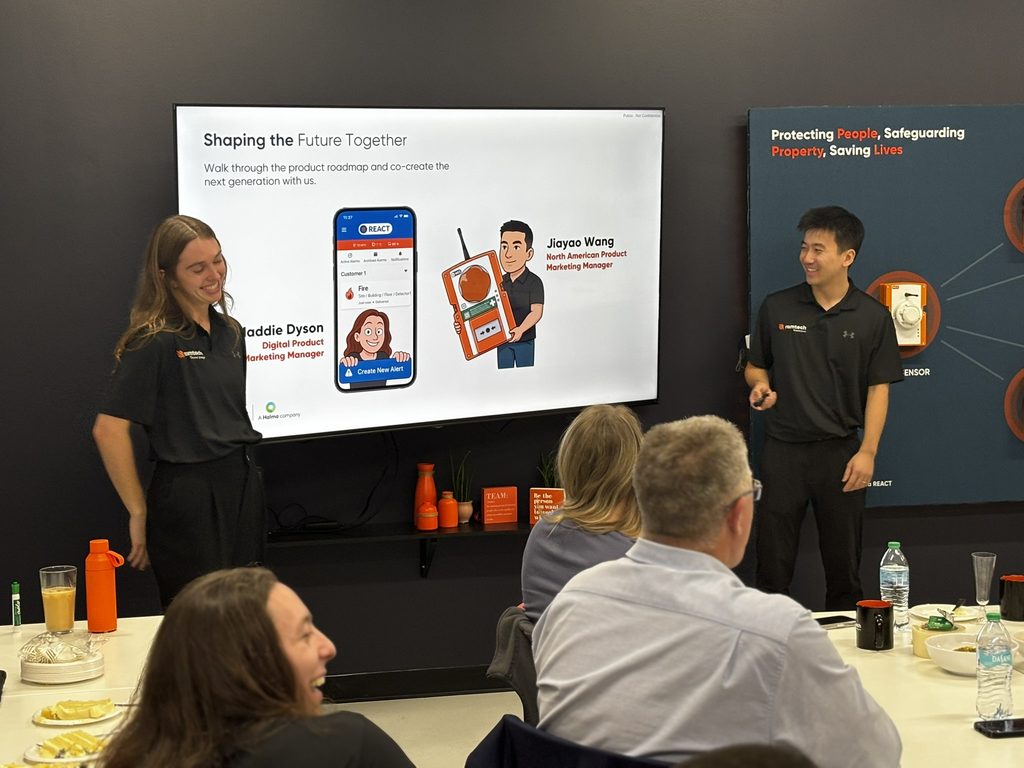

Jiayao is not alone in this experience, all the Catalyst participants share a deep passion for continuous growth and improvement, which is why pushing oneself out of their comfort zone is paramount. Stephanie Haro, Digital Product Marketing Manager for Hyfire UK, highlights the importance of such: “I think adaptability is a huge factor when it comes to being successful. This program does a perfect job of presenting you with scenarios that stretch you. I think being open to learning, asking questions, seeking feedback, and being able to step outside of your comfort zone are crucial. Because when you do that, you’re probably going to strengthen your weaknesses and learn new skill sets.”
We are living in unprecedented times. Where 30 years ago people were able to follow a relatively straightforward pathway from education to employment, today it has become a winding road with no clear destination in sight. This change, however, comes with a hidden advantage, one that Halma is clearly leveraging: innovation. Orama was built on this foundation, keeping people and their environments safe through innovative solutions. All of the companies within the group are revolutionising the fire safety industry through the use of wireless technology. Hyfire’s systems allow for quick installation without the need for invasive work, Ramtech offers fire protection to temporary sites and all of their products are manufactured in Argus’ state-of-the-art facility. This kind of innovation wouldn’t be possible without a team that is ready and willing to think outside the box.
“One must have the right mindset and desire, the eagerness to learn without the fear of failure. It’s important to try new things and throw yourself into new markets, new functions, new jobs, new countries that you never would have imagined yourself in – Michael emphasises – If you open up your horizons like that, then I think the world is at your fingertips.”
Furthermore, Madison highlights how the true benefit of the programme is working with such a global workforce: “I think there’s two major things that stick out to me from my time in the Catalyst programme: humility and collaboration. At times, it was a bit scary to walk into a completely new operating company, in an area of the world that I’ve maybe never been to before, and coming from a place of not knowing anything about the role or the people or the product that I’m going to be working with. Having to have that humility to say I don’t know what I’m doing quite yet, but I’m surrounded by a really strong team of people who do and giving them the time and the space to be able to teach and be able to convey that knowledge to me was really inspiring.”
In the UK, only 60.1% of graduates aged 21-30 work in “high-skilled” positions. This staggering statistic shows that there is an untapped potential, with almost 40% of educated young people ready to bring their diverse knowledge and skills to a variety of sectors. Employers have to see how the formal requirements of the past are not enough for today. Different perspectives lead to different solutions and push innovation forward, but to do so, young people must be given the opportunity to try, fail and learn. In chemistry, ‘Catalyst’ is a term that refers to something that accelerates a chemical reaction without itself being changed. That is exactly what a graduate job should be: an event that causes great change without fundamentally changing the person.
When asked if she had any advice for people starting their careers today, Stephanie embodied the Catalyst spirit: “Early in your career is the best time to try new things, even if it’s uncomfortable at first. Put yourself in those unfamiliar situations because you’re going to build confidence, you’re going to become stronger in areas that were definitely weaker and develop new skills… because at the end of the day, everyone is just trying their best, so if you try your best you’ll fit in just fine.”
